RUSTIK Project Meeting in Cheltenham: Advancing Insights for Europe’s Rural Future

The upcoming RUSTIK project meeting in Cheltenham, UK, will bring together partners from across Europe to advance the project’s understanding of rural transformation. The main focus of the meeting will lie in the thematic workshops established as part of Work Package 5 (WP5): Refined Understanding of Rural Dynamics, Impact Assessment, and Conclusions.

These workshops represent a key step in connecting findings from across RUSTIK’s Living Labs, refining insights, and co-developing recommendations that can strengthen the resilience and sustainability of Europe’s rural regions.

Each thematic workshop will bring together a dedicated group of Living Labs, each assigned based on their core expertise and regional context.

Core Themes of the Cheltenham Workshops
  1. Socio-economic vitality and rural businesses
    Discussions will explore strategies to reinforce rural business ecosystems, enhance local innovation, and build socio-economic resilience in the face of ongoing transitions. For the “Socio-economic vitality – Strengthening Rural Businesses” workshop, the assigned Living Labs are Mazowieckie and Świętokrzyskie in Poland,  and Nockregion – Oberkärnten, Austria, each known for proactive support of rural enterprises and rural economic development.
  1. Environmental and institutional transition
    Sessions will focus on climate adaptation, sustainable resource management, and the role of data-driven development in supporting greener and smarter rural futures. The Environmental and Institutional Transition – Land Use, Natural Resources & Data Tools workshop will feature the Living Labs from Parma, Piacenza & Ferrara (Italy), Galicia (Spain), Osona (Spain), and Gloucestershire (United Kingdom) as the main contributors. These regions are recognized for pioneering efforts in landscape management, innovative data usage, and integrated territorial governance.
  1. Sustainable food and forestry systems
    Participants will share best practices and explore collaborative approaches for ensuring robust, sustainable food production and forestry management. For the Socio-economic Vitality – Sustainable Food/Forestry Systems workshop, the assigned Living Labs are Troyan-Apriltsi-Ugаrchin (Bulgaria), Garfagnana (Italy), and Zaječar District (Serbia). Each of these regions brings significant experience in enhancing rural food production systems, supporting agri-food value chains, and promoting forestry innovation.
  1. Social cohesion and inclusion
    Workshops will address how to foster equality, social inclusion, and thriving communities as essential pillars of sustainable rural development. The Social Cohesion – Stimulating Social Inclusion workshop will be led by the Living Labs from Rhein-Hunsrück (Germany), Osrednjeslovenska regija (Central Slovenia), North Karelia (Finland), and Monmouthshire (United Kingdom). These regions each bring extensive experience in fostering inclusive rural communities, developing vibrant networks, and supporting diverse social initiatives.

These discussions build on the foundations of WP1 Conceptualising functional rural areas, transition and resilience of rural areas and the latest findings from 14 Living Labs, with the aim of synthesizing key lessons and translating them into concrete recommendations for rural policy and practice. The workshops are part of Task 5.1, led by BAB, in close collaboration with partners and Living Lab teams.

Beyond the Workshops: A Rich Programme of Activities

While the workshops form the heart of the meeting, several complementary activities will offer valuable opportunities for learning, reflection, and collaboration.

  • Work Package Coordination Meetings: Dedicated sessions for WP and task leads will support strategic alignment and ensure coherence across the project’s workstreams.
  • Site Visits to Gloucestershire and Monmouthshire: Participants will have the chance to visit these two Living Lab regions, gaining first-hand insights into local rural dynamics, challenges, and innovative practices driving regional transformation.

The outcomes of the Cheltenham meeting will play a crucial role in shaping RUSTIK’s scientific outputs and final European-wide seminar. Insights gained will inform transition pathways and generate actionable recommendations for strengthening rural resilience, sustainability, and inclusion across Europe.

As the RUSTIK community gathers in Cheltenham, this meeting promises to be a catalyst for collaboration — advancing shared understanding and contributing to the vibrant future of Europe’s rural regions.

Exploring Innovative Responses to Rural Demographic Challenges

Join the First RUSTIK Regional Workshop

Date: 5th June 2025

Time: 14:00 – 16:00 EET
Location: Vaarasali Auditorium, Koli Nature Centre Ukko, Finland  & Online

Check the full agenda

Register here


Across Europe, rural regions are facing complex and rapidly evolving demographic challenges — from youth outmigration to changing labour market needs and shifting patterns of immigration. Addressing these issues calls for tailored, place-based solutions rooted in both research and practice.

On 5th June 2025, the first RUSTIK Regional Dissemination Workshop, titled “RUSTIK Living Labs in Action: Responding to Rural Demographic Challenges”, will bring together researchers, practitioners, and policymakers to exchange insights and inspire change.

Why This Workshop Matters

Rural areas are not uniform — each faces unique challenges and opportunities when it comes to demographic shifts. Yet, through shared dialogue and the exchange of good practices, regions can learn from each other and co-create more resilient futures. The RUSTIK project supports this goal by developing Living Labs — regional innovation hubs that experiment with real-world solutions to rural issues.

This workshop focuses specifically on labour market dynamics, immigration, and youth engagement, spotlighting work from three RUSTIK Living Labs:

What to Expect

This two-hour hybrid event is designed to be both informative and interactive. The program features expert presentations, Living Lab case studies, and a moderated panel discussion. Participants can contribute questions and insights in real time through online tools like Slido, ensuring dynamic engagement from both on-site and remote attendees.

Join Us — Onsite or Online

Whether you’re a regional policymaker, researcher, civil servant, or rural development practitioner, this workshop is an opportunity to connect with a growing European network committed to rethinking rural futures.

Mark your calendar and get ready to share, learn, and co-create.

RUSTIK at the RSA 2025 Annual Conference in Porto

The RUSTIK project is participating in the 2025 Regional Studies Association (RSA) Annual Conference, taking place from 6–9 May 2025 at the Faculty of Economics, University of Porto, Portugal. The conference gathers researchers, policymakers, and practitioners from across the globe to discuss pressing regional development challenges, and RUSTIK is proud to contribute to these conversations with two key presentations that reflect our project’s commitment to advancing data-informed rural policymaking.

A highlight of RUSTIK’s presence at the conference will be the presentation by Francesco Mantino and Barbara Forcina, from CREA – Research Centre for Agricultural Policies and Bioeconomy, titled “Analysing the Agri-food Chain Impacts on the Broader Local Economy through a Set of Governance Indicators: An Application to Two Processed Tomato Chains in Europe.” This research introduces a new approach to measuring the effects of agri-food supply chain governance on local economic development and territorial resilience, with case studies from Northern Italy and Extremadura (Spain). This session will take place on Wednesday, 7 May 2025, from 14:00 to 16:00 WEST in Room 613 (Bloco 600), as part of the “Sustainability Transitions and the Environment: Farming and Eco-Restoration” theme.

In addition, Francesco Mantino, Research Director at CREA-PB and leader of RUSTIK Work Package 1 (“Understanding”), will also present his study “Understanding and Measuring how Demographic Changes Impact Rural Areas and their Diverse Responses to European Policies.” This work develops a typology of rural areas based on demographic change and evaluates how these patterns influence the uptake of EU funding across Italy. Using both aspatial and spatial econometric models, the research provides insights into how local demographic conditions shape access to RDP, ERDF, and ESF programmes, highlighting the need for more territorially sensitive approaches to EU funding mechanisms. This second session will take place during the “JRC: Smarter, Stronger and Resilient Rural Areas I” panel on Wednesday, 7 May 2025, from 16:30 to 18:30 WEST, in Room 163.

These contributions showcase RUSTIK’s broader aim of enhancing the evidence base for rural policy design and supporting the implementation of context-aware, inclusive strategies for rural development. We are proud to collaborate with leading experts and institutions in this effort and look forward to sharing key outcomes from the conference.

For more information about the conference, visit: https://www.regionalstudies.org/events/2025-annual-conference-porto/

RUSTIK to Feature at the European Congress on Renewal and Rural Development in Poznań

On the second day of the European Congress on Renewal and Rural Development, taking place from 8 to 10 May at the MTP Poznań Expo, the RUSTIK project will be featured in a dedicated session focused on strengthening rural communities through sustainable transformation.

The Congress, organised by the Polish Ministry of Agriculture and Rural Development in cooperation with the Greater Poland regional government and under the Polish Presidency of the Council of the European Union, brings together over 1,500 participants from across Europe, including policymakers, researchers, NGOs, and rural leaders.

During the session titled “RUSTIK: Strengthening rural communities on their way to sustainable transformation”, our partners Ewa Korcelli-Olejniczak from the Institute of Geography and Spatial Organization (IGSO PAS) will represent the Woj. Mazowieckie Living Lab in Poland (this Living Lab is co-organised in cooperation with the Foundation for the Development of Polish Agriculture (FDPA)), while Ilona Rac from the University of Ljubljana will represent the Osrednjeslovenska regija Living Lab.

They will present key insights from the RUSTIK project, which supports rural areas in addressing complex challenges through a combination of data-driven analysis and community-based approaches, helping to guide sustainable and inclusive rural transformations.

RUSTIK’s participation aligns with the Congress’s emphasis on rural resilience, inclusive development, and innovation, contributing to the broader conversation on the future of rural Europe.

The event opens on 8 May with a full day dedicated to Greater Poland, Regional Development and Youth, highlighting the region’s achievements in rural renewal, the role of women in leadership, and the perspectives of youth on the future of rural areas. The first day also included sessions on food production, health, education, local governance, and rural tourism, setting the stage for in-depth discussions over the following days.

The Congress continues through 10 May with further sessions on agricultural policy, international cooperation, and the future of rural development in the EU beyond 2027.

The role of data in driving transitions in rural areas | RUSTIK webinar

On 30 April, the RUSTIK project hosted an online event to explore the role of data in supporting rural transitions and shaping sustainable futures, gaining insight from the Horizon Europe RUSTIK project (Rural Sustainability Transitions through Integration of Knowledge for improved policy processes).

Rural areas provide ecosystem services, high-quality land-based products, cultural assets, and more. Nevertheless, they face increasing social and ecological challenges including demographic change, climate change, a digital divide, and limited economic diversification.

To navigate these complexities and support sustainable development, data plays a crucial role in guiding these territories toward transition pathways.  By advancing our understanding of different rural functions, characteristics and future scenarios for rural areas, data can help identify their potentials and challenges, enabling more informed place-based policies and targeted interventions.

This online conference brought together experts, project partners, and regional representatives to discuss key challenges such as data access, protection,  and integrating data in decision-making. Participants heard real-world experiences from pilot regions, engaged in hands-on workshops using the data viewer tool, and took part in meaningful discussions on the future of rural areas.


Missed the webinar? No worries! The recording is now live!


RUSTIK MIDTERM Draft Agenda

RUSTIK Project Meeting in Millstatt: A Successful Gathering

RUSTIK Project Meeting in Millstatt: A Successful Gathering

From October 14th to 17th, 2024, the RUSTIK project team held a productive meeting in the scenic town of Millstatt, Austria. This event brought together project partners, the External Advisory Board (EAB), and stakeholders to discuss key milestones and the next steps for the project as it moves into its third year of execution.

Key Highlights of the Meeting:
  • General Assembly & Project Updates: The meeting kicked off with a welcome from our hosts at RVN and reflections on the second year of the RUSTIK project. Can you imagine our 2nd year of Rustik as a journey on a sailboat? That’s what we did on our last meeting in Austria, having wind as our motivation, anchors as obstacles to overcome, rocks as the future risks, and land as our goal. Teamwork is key, so, in small groups, we discussed each of these tasks to reach a global vision. Partners shared insights and interactive sessions focused on Living Lab implementation and planning for the third cycle.
  • Living Lab Discussions: Lightning talks showcased the progress of data experiments in the Living Labs, with each lab providing updates. These presentations were followed by breakout discussions focusing on challenges, data experimentation, and the transition from research to policy. Some of the Living Labs also produced posters highlighting the results of their data experiments after completing the implementation phase, adding a visual dimension to their findings.
  • External Advisory Board (EAB) Meeting: Held in a hybrid format, the EAB provided valuable feedback on implementation and dissemination strategies. The discussions centered on key topics such as Functional Rural Areas, Rural Proofing, and the development of the Data Viewer tool, offering crucial insights for the next phase of the project.
  • Dissemination & Future Collaboration: Dissemination efforts were a key focus, with discussions on joint publications and future collaborations to extend the impact of the project beyond 2025.
  • Excursion to Nockberge Biosphere Park: The group enjoyed an excursion along the Nockalmstrasse to the artists’ town of Gmünd, which offered time for networking and exploring the local culture.
Looking Ahead:

With the meeting in Millstatt successfully concluded, the RUSTIK team is now focused on finalizing the third cycle of the Living Lab experiments and preparing for the mid-term conference in April 2025, which will be part of the Rural Pact Conference.

Stay tuned for further updates on our progress and upcoming events!

RUSTIK създаде 14 живи лаборатории за насърчаване на прехода към устойчивост в селските общности

RUSTIK (Rural Sustainability Transitions through Integration of Knowledge for Improved Policy Process – Преходи за устойчивост в селските райони чрез интегриране на знания за подобрение на процеса по създаване на политики) е четиригодишен трансдисциплинарен изследователски проект. Проектът има за цел да даде възможност на участниците в селските общности и на създателите на политики да разработят по-добри стратегии и инициативи, насърчаващи прехода към устойчивост в селските райони.

Проектът, финансиран от програма “Хоризонт Европа”, предвижда анализ на настоящите изисквания за адаптация, както и подкрепяне на ефективните политики в селските райони за по-доброто разбиране на различните функционалности и характеристики на районите, потенциалите  им и предизвикателствата пред тях. Основните трансформации, които ще бъдат проучени в рамките на проекта, са свързани с измененията в околна среда, климата, социално-икономическите динамики и цифровите технологии.

Живите лаборатории в 14-те  пилотни региона в 10 европейски държави ще бъдат централният елемент за генериране на нови познания за разнообразието на селските райони и обществените трансформации в тях. Живите лаборатории на RUSTIK ще работят по идентифицирането на нови данни, методи за събиране на данни, съчетани с настоящите източници, за да се създадат релевантни индикатори за измерване и справяне с предизвикателствата. Проектът ще се съсредоточи върху интегрирането и разпространението на данни, за да направи информацията и анализа достъпни и ценни за участниците и създателите на политики, подобрявайки въздействието на политиките, които се прилагат в селските райони. Крайната цел е да се окаже въздействие върху стратегиите за развитие и начина им на създаване, приложение и управление. За целта се предвиждат три последователни етапа, които ще се извършат от партньорите по метода на „Живата лаборатория“: преглед на ситуацията, експериментиране с данни и изучаване на политиките.

Тази седмица академичните партньори по проекта се събраха на начална среща, организирана във Франкфурт от координатора на проекта – Института за изследване на развитието на селските райони (IfLS).

Мултидисциплинарен консорциум

Консорциумът включва 30 партньорски организации. Осем университета и четири научноизследователски института предоставят научна експертиза в областта на развитието на селските райони, пространственото планиране и отчитане, процес на разгръщане на  политиките, устойчивост и изменение на климата; две основаващи се на знанието предприятия от категорията малки и средни (МСП) допринасят за това с готови за прилагане технологии и подходи; а две НПО действат като посредници между университетите и МПС.

Местните и регионалните партньори осигуряват ориентирано към практиката изпълнение на проекта. Обхванати са  партньори от пет местни или регионални публични администрации, две местни инициативни групи (МИГ), три бизнес асоциации и три агенции за регионално развитие.

Две европейски организации, представляващи заинтересовани страни в планинските райони – Euromontana и Европейската асоциация LEADER за развитие на селските райони, ELARD – са ключови мултипликатори за други европейски региони и по-специално подпомагат разпространението на информация сред институциите и гражданите на Европейския съюз.

Усилията на консорциума ще допринесат за укрепване на съществуващите инструменти и подходи на европейската политика, най-вече в подкрепа на Европейската зелена сделка, Европейската стратегия в областта на цифровите технологии, Европейския стълб на социалните права и Дългосрочната визия на ЕС за селските райони на Европейския съюз, политиката на ЕС за сближаване, общата селскостопанска политика, и по-специално Европейския фонд за гарантиране на земеделието (ЕФГЗ) и Европейския земеделски фонд за развитие на селските райони (ЕЗФРСР).

Exploring European Geospatial Data Tools

The Rustik partners are continuing their learning journey, acquiring new insights to develop their data experiments. Recently, MCRIT and the Universidad Autónoma de Barcelona organized a training session on European geospatial data tools. Participants gained skills in data visualization, downloading capabilities, and basic analysis, focusing on:

  • Using web tools to search and download satellite imagery and related data.
  • Conducting visual analysis of geospatial data, including comparisons and time-lapse views.
  • Identifying and accessing relevant data for specific areas of interest.
  • Applying geospatial data tools effectively in their work or projects.

Copernicus Tools: Copernicus, the EU’s Earth observation program, provides free and accessible information services from satellite and in-situ data sources. Tools include:

  • Sentinel-1: Radar imagery for land and ocean services.
  • Sentinel-2: High-resolution optical imagery for monitoring vegetation, soil, and water.
  • Sentinel-3: Data for marine and land services, such as ocean and land surface temperature.
  • Sentinel-6: Altimetry data for measuring global sea-surface height.

Copernicus Data Space Ecosystem CDSE This platform offers real-time data access, customizable imagery rendering, and extensive cloud options for processing Copernicus data.

Copernicus Land Monitoring Service (CLMS): Provides essential land cover information for applications in spatial planning, agriculture, and climate change mitigation.

EEA and JRC Tools: The European Environment Agency (EEA) and Joint Research Centre (JRC) offer tools like the JRC Data Catalogue, European Drought Observatory, Urban Data Platform, and European Soil Data Centre (ESDAC). These tools support various applications in spatial planning, forest management, water management, agriculture, and more.

Explore these tools and data resources for informed decision-making and impactful projects.

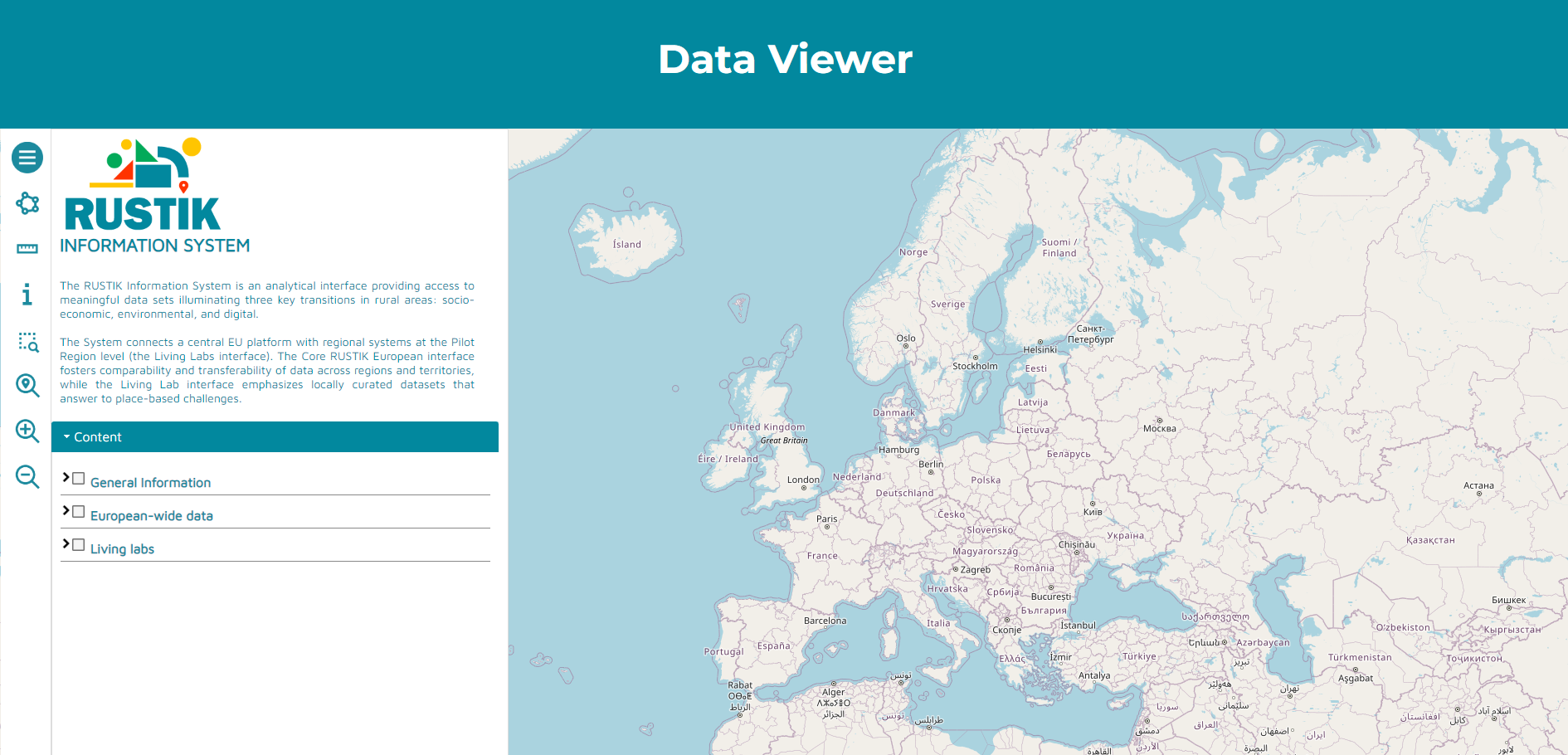
RUSTIK Data Viewer Now Available! Empowering Rural Sustainability Transitions

Rustik Data viewer now available!

We are thrilled to unveil the launch of the RUSTIK Data Viewer, a powerful tool designed to revolutionise evidence-based decision-making and drive positive impacts in rural sustainability transitions.

What is the RUSTIK Data Viewer?

The RUSTIK Information System is more than just a tool; it’s a reliable resource crafted to facilitate comprehensive insights into rural sustainability transitions, encompassing social, economic, environmental, and digital dimensions. At its core, the system serves as a centralized platform, providing seamless access to data meticulously curated within the RUSTIK Database.


Who Benefits from the RUSTIK Data Viewer?

This innovative system isn’t just for researchers and policymakers; it’s for anyone passionate about rural sustainability. From policymakers shaping legislative frameworks to academics conducting groundbreaking research, the RUSTIK Data Viewer caters to a diverse spectrum of stakeholders invested in rural development.

Key Features and Functionalities:

The RUSTIK Data Viewer boasts an intuitive user interface designed with your convenience in mind. Navigate effortlessly through layers of data, gaining valuable insights at every turn. Here’s a glimpse of what awaits you:

  • Layers Menu: Seamlessly transition between the European Core and 14 Living Lab Cores.
  • Area Draw Tool: Customize shapes and areas on the map to suit your analysis.
  • Measure Tool: Accurately measure distances to inform your decision-making process.
  • Information Tool: Dive deep into specific elements or locations on the map, accessing associated attributes with ease.
  • Zoom Functionality: From zooming into specific regions to gaining a holistic view of the entire EU extension, the zoom features empower you to explore with precision.

The Richness of RUSTIK Database:

The backbone of the RUSTIK Data Viewer lies in the extensive RUSTIK Database, meticulously curated to capture economic, social, and environmental indicators. From sectors and employment to quality of life and climate change mitigation, our database is a treasure trove of invaluable insights.

Unveiling Diverse Data Sources:

Our commitment to robust analysis extends to diverse data sources, including:

  • Data from European agencies and programs, such as Eurostat and the European Environmental Agency.
  • Insights from private actors, NGOs, and research institutions, enriching our understanding of consumer behavior and specialized research.
  • Geo-data scraping from platforms like Open Street Map and Google Maps, offering a wealth of geospatial information for in-depth analysis.


The RUSTIK Viewer isn’t just a tool; it’s a catalyst for change. Join us as we embark on a journey to transform rural sustainability transitions. Explore the RUSTIK Data Viewer today and be part of the movement towards a more sustainable future.

At RUSTIK, we believe in the power of data to drive meaningful change. With the RUSTIK Viewer, we empower you to make informed decisions that pave the way for a brighter, more sustainable tomorrow.

Visit our website to access the RUSTIK Data Viewer and unlock a world of possibilities. Together, let’s shape the future of rural sustainability, one data point at a time.

Data Scraping Training Recap!

Data Scraping Training session Rustik toons at the workshop, talking to each other next to a giant computer with a presentation on it.

A Data Scraping Training session was hosted by MCRIT Multicriteria Planning, Work Package 2 (Co-design of data collection approaches, databases, and RUSTIK information system) leaders on 29 April, 2024. This training was tailored to meet the specific needs of Living Labs involved in the data experimentation process.

 What is Data Scraping?

Data scraping, also known as web scraping, is the automated process of extracting information from websites or databases. This enables us to efficiently gather large volumes of data for analysis, uncovering valuable insights and trends.

 Training Highlights

  • From Data to Geospatial Information: Participants learned how to convert raw data into meaningful geospatial information. This process is crucial for visualizing and understanding the spatial dimensions of the data collected.
  • Relevance of Geographical Information for RUSTIK: This part of the session highlighted the importance of geospatial analysis. Moreover, participants gained insights into territorial dynamics and learned how geospatial data facilitates informed decision-making in various domains such as urban planning, environmental management, and transportation logistics.

Scraping Techniques

Attendees discovered methods to extract data from various online sources, automating the process for streamlined workflows and access to up-to-date information. Tools such as Apify and Geofabrik were introduced.

  • Apify: A platform that allows users to automate web scraping tasks without writing any code, making it accessible to users of all skill levels.
  • Geofabrik: Provides geospatial data extracts and tools for OpenStreetMap, enabling users to access and process geographic data for a wide range of applications.
  • Transforming Scraped Data into Useful Information for Living Labs: the training focused on how to process and transform the data extracted from websites into actionable insights for the Living Labs‘ experimentation processes. Participants learned best practices for cleaning, structuring, and analysing the data to support their specific needs and objectives.

To conclude, as the training wraped up, it’s time to put the knowledge into action. Our Living Labs partners will leverage these tools for their data experiments. Stay tuned and follow the project to catch the exciting results!